


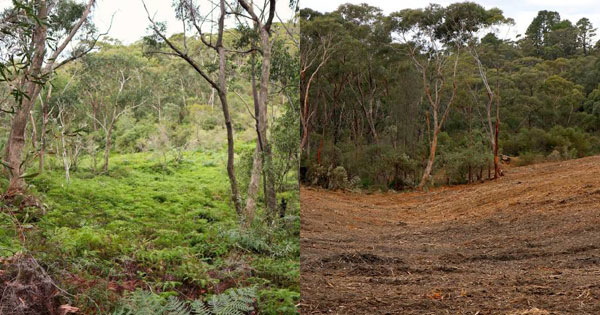
 Before and after (courtesy Blue Mountains Gazette)
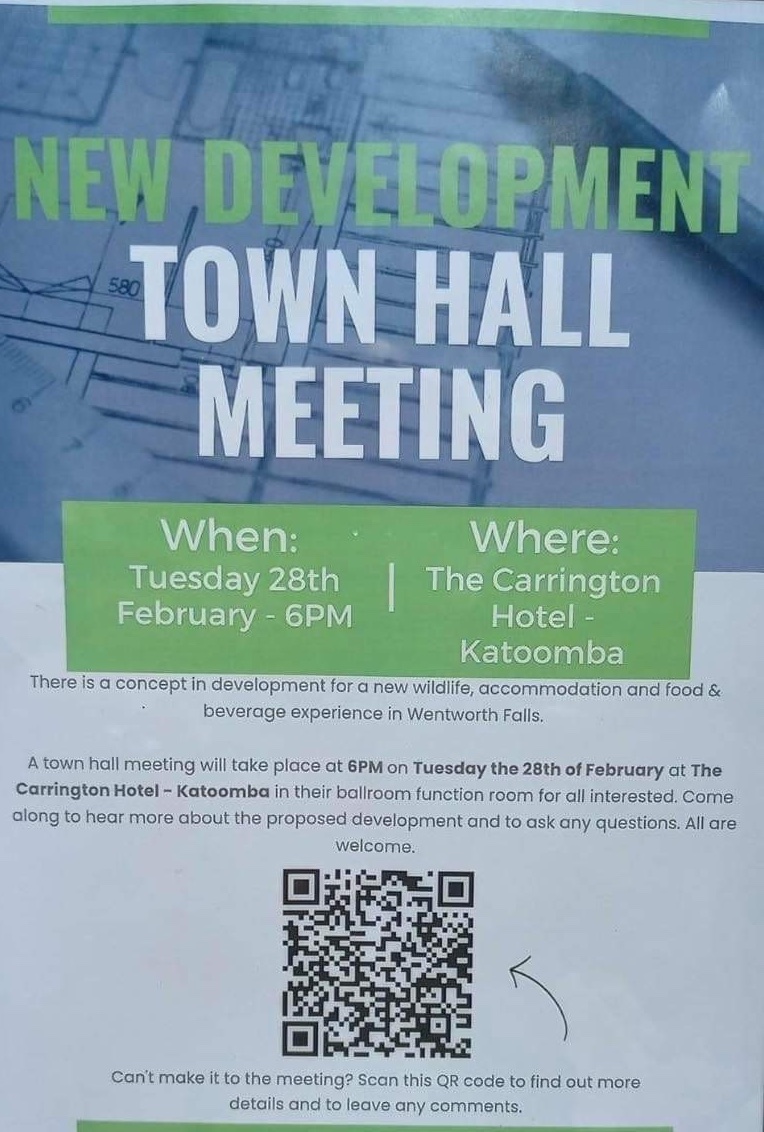
Report on Wentworth Falls zoo and hotel ‘Town Hall Meeting’ 28 February 2023
Over 100 people turned up at a heated public meeting convened by representatives of the developer at The Carrington Hotel, Katoomba, on February 28th. Spokesperson for the development, Farshad Amirbeaggi, presented an updated concept plan for the Wentworth Falls ‘wildlife park’ and hotel. Members of the Blue Mountains Conservation Society attended.
While the revised development is similar to that proposed 2 years ago – a luxury hotel and conference centre, multi-level carpark, restaurants, cafes, vet clinic and indoor and outdoor wildlife exhibits – it appears to be even larger than originally proposed. New features include a suspension bridge, ropes course and zipline in the Environmental Conservation area.
A new entry to the development is proposed further up the hill on the highway where the meshed stone wall starts. The new intersection will require breaching the concrete crash barrier and installing traffic lights. This new traffic arrangement is necessary because the impractical access to the development from Miller St, included in the 2021 plan, has now been dropped.
Although audience members, which included residents abutting the development, asked for more details on the plan, Mr Amirbeaggi was not able to provide them. And responding to a question from the audience, Mr Amirbeaggi said there would be a reptile exhibit and he was not ruling out crocodiles. The new plans only increase the Society’s concerns. In particular the development appears to:
- further encroach into highly sensitive areas, including hanging swamps
- require substantial clearing of the bushland buffer between Bullaburra and Wentworth Falls
- potentially pollute the creek and hanging swamps on the site and the national park downstream
- impact on an established wildlife corridor
See the Blue Mountains Gazette report on the meeting
A new development proposal for the Boddington Hill site has recently been flagged. Not many details are available at this stage. A PR firm, Hall & Partners, has organised a 'town hall' public meeting to discuss the new concept:
Time and Place: 6pm on Tuesday 28 February 2023
Venue: The Ballroom Function Room at the Carrington Hotel, Katoomba.
Please attend. It's important to have as many people as possible who know the history of development attempts on this site at this public meeting.
See the only details publicly available: New Proposal
Concept plans and the Secretary’s Environmental Assessment Requirements (SEARs) for Bodington zoo/hotel now posted on the Department of Planning’s 'Major Projects’ website.
These concept plans are not on public exhibition; rather, they were part of the development proponent’s request to the Department of Planning to issue a Secretary’s Environmental Assessment Requirements (SEARs). The SEARs has now been issued and posted, along with the advice from various government agencies and the Blue Mountains City Council.
The SEARs lists the issues that the development proponent must address in the Environmental Impact Statement (EIS). The EIS will be publicly exhibited along with the development application. We will inform members when the EIS and development application come on exhibition.
The Society expects the Department of Planning to conduct public information meetings at the time of exhibition.
What’s proposed?
- A 56-room hotel housed in five separate 2 and 3-storey buildings, conference facilities and restaurant/bar.
- Parking for 8 coaches, and what appears to be a multilevel semi-underground 250-space car park excavated into the hillside.
- Indoor and outdoor zoo exhibits. Indoor exhibits include possums, lizards, gliders, aviary; outdoor ‘free-range’ exhibits include (indicatively) kangaroos, wallabies, echidnas, wombats, emus, koalas, possums, cassowaries, dingoes, numbats, quokkas, aviaries; ‘premium exhibits’ fronting the hotel buildings include animal feeding and petting ‘experiences’ and ‘Koala View Rooms’.
- A theatre, vet clinic, café, gift shop.
Some preliminary issues of concern to the Society
The proposed development is enormous and, as we feared, literally cannot fit into the current development zone on this site. It therefore spreads out beyond the development zone into the surrounding high ecological value E2 Environmental Conservation zone. The conditions of development consent for the old ‘croc park’ required all sections of the development to be contained within the development zone.
Zoning and other restrictions on the development in the Blue Mountains LEP can be over-ridden by State Significant Development approval. This would set a terrible precedent in the Blue Mountains in particular, whose LEP is the most locally-tailored in the state because of the region’s high environmental, visual and World Heritage values.
Environmental issues
- Half of the hotel buildings, all the carparks and most of the internal roads, the restaurant/bar, some exhibition buildings and the free-range animal exhibits confined by perimeter fencing are sited in the E2 zone. All the above are currently prohibited in the E2 zone.
- Part of the car park and the Miller St road access are located on land of slope 20-33% and some walking trails appear to be located on land of slope greater than 33%. Parts of the development, clearing for an Asset Protection Zone (APZ) and, it appears, the lagoon, seem to be sited near or on the LEP 2015 Protected Area-Slope Constraint. The concern here is that vegetation clearing and soil erosion will introduce silt pollution into the swamp and watercourse and down into Bedford Creek in the National Park/World Heritage Area.
- Walking tracks, raised walkways and ‘free range’ animal exhibits appear to be located in areas of hanging swamp and the riparian corridor in the E2 area. We are concerned about the impact of the entire development, including the ‘free range’ animals, on the swamp and watercourse feeding Bedford Creek downhill in the National Park/World Heritage Area.
- Stormwater and runoff management on this steeply sloping site, as well as water purification before discharge into the National Park/World Heritage Area, are critical but present extreme challenges which have not been addressed in any detail at this ‘concept’ stage. This needs to be addressed in the EIS.
Biodiversity impacts
The wildlife tunnel under the highway is highly likely to be rendered inoperable by the development. The tunnel exit/entrance is on Transport for NSW land, although it currently opens into the site behind the fence. When the site is fenced for the development, animals exiting the tunnel will be trapped outside the fence on the edge of the highway.
We are also concerned about the welfare of the exhibited animals and the biosecurity risk of interaction between wild and captive animals and escapes of exhibits into the adjoining bushland and National Park/World Heritage Area. Some of the proposed exhibits are not indigenous to the Blue Mountains.
Visual Impact
The site is mapped as ‘Land between Towns’ under the LEP which is designed to ensure natural bushland breaks between the villages. The loss of scenic values and the bushland buffer between Bullaburra and Wentworth Falls is unavoidable in our view. The proposed hotel height (12m) is 4m higher than the allowable 8m height limit on the site. The proponent has indicated that they will be arguing that the height restriction is ‘unreasonable and unnecessary’.
Highway access
Vehicular access to the hotel/zoo will be by the Great Western Highway and Miller St at the western end of the site. A Miller St access to the site was also proposed in the original ‘croc park’ development but was always a challenge because of the very steep slope up the escarpment. After a strong campaign by Miller St and Tableland Rd residents objecting to the impact of tourist traffic through their quiet, narrow streets, the then Council explicitly prohibited the use of Miller St in the conditions of consent for the ‘croc park’ development.
The highway access remains a challenge, with the concrete crash barrier precluding any right hand turns into and out of the site for eastbound visitors. The proponent has indicated that right hand turns on the highway will be an option for investigation in the EIS.
Parking
Parking is a major issue because of the limited space on the site. The proponent has indicated that they expect to attract patronage exceeding 2 million per annum. That’s an average of 5,500 visitors a day on the 363 days that the zoo will be open.
The proponent states that there will be parking for 250 cars and 8 coaches. This amount of car parking on the site requires what appears to be a 4-level semi-underground carpark excavated into the hillside.
Bushfire
Details of bushfire threat management have been deferred to the EIS/development application stage. However, what is shown on the concept plans is the estimated Asset Protection Zone (APZ). Normally, a development on a site mapped as high bushfire risk Vegetation Category 1 would require clearing an area of 100m around the buildings. In this case, this would mean effectively clearing the entire site. The APZ shown in the concept plans is not 100m and in places directly abuts the hotel buildings. Whether this is viable and acceptable to bushfire authorities should become apparent in the EIS and development application.
All these issues will have to be addressed in detail in the EIS and development application. The proposal could change substantially as a result.
On January 22, 2021 the Blue Mountains City Council issued a media release stating it had been notified that a new and larger proposal for a wildlife park at Wentworth Falls will be treated as a State Significant Development (SSD). The NSW Department of Planning told the Gazette (January 27, p.4) that the proposal qualifies as a State Significant Development “because it is a zoo with a capital investment value (CIV) greater than $30 million and a development for other tourist-related purposes with a CIV greater than $100 million)”. All up, the plans are for a $194 million wildlife park and tourism development which could include a 56-room hotel, food and beverage facilities, souvenir and gift shop, a function centre, education and cultural exhibits, walking trails and viewing platforms.
The significance of SSD status is that the development does not need to comply with local planning frameworks and will bypass local approval. Instead, the proposal will be assessed and approved by the NSW Government-appointed Independent Planning Commission or the Minister for Planning. As Mayor Mark Greenhill told the Gazette, “Council’s role is essentially reduced to being able to make a submission”.
The Blue Mountains Conservation Society shares Council’s concerns about the proposal bypassing local environmental protection standards, setting a precedent for development in the bushland buffer between towns and jeopardizing the World Heritage Area.
Given its environmental sensitivity, the majority of the site is zoned E2 Environmental Conservation under the Blue Mountains LEP, which prohibits intensive development. The remainder of the site is zoned E3 Environmental Management, which includes the area identified for development under the existing 30-year-old ‘zombie’ development approval. It is very hard to imagine that a hotel and associated developments, such as a function centre, internal access roads and car and bus parking, as well as a zoo and associated tourist facilities, such as a cafe and gift shop, can be contained on the small portion of the site currently zoned for development. However, such restrictions (along with others) may be over-ridden by State Significant Development approval.
Environmental issues
The location of the proposed zoo and hotel at Bodington Hill, on the site of the old ‘croc park’, is highly constrained and many significant environmental issues must be considered in the assessment and approval process.
- The site is steeply sloping, representing extreme challenges in terms of management of stormwater and runoff especially given the likelihood of extensive hard surfaces (e.g. car and coach parking) and expected nutrient load from the zoo.
- A significant Blue Mountains swamp lies directly downhill of the development area which feeds Bedford Creek, an important waterway within the Blue Mountains National Park. Impacts on the swamp and watercourse in terms of changes in hydrology and water quality need to be fully assessed as well as impacts on groundwater.
- The site is mapped as having a high bushfire risk, requiring a significant asset protection zone surrounding the development, resulting in further impacts on native bushland and visual amenity.
- The site is within an established north south wildlife corridor - the existing wildlife tunnel under the highway is likely to be rendered useless if the site is developed.
- European and Aboriginal heritage values of the site need to be fully assessed, especially given significant Aboriginal heritage sites exist nearby on Kings Tableland.
- Assessment of the loss of scenic and amenity values is required. The site is mapped as ‘Land between Towns’ under the LEP which is designed to ensure natural bushland breaks between the villages. This is incompatible with the proposed intensive tourism development.
- Assessment of the impacts of any further removal of native vegetation, including impacts on threatened flora and fauna, which have previously been recorded on the site.
- Impacts of the zoo on native wildlife including provision of inappropriate food sources, noise and lights.
Traffic and parking
In addition to the environmental values, traffic and car parking impacts need to be carefully evaluated including road safety. When the original, much less ambitious development was approved over thirty years ago, traffic management including entry and exit to the Great Western Highway was the critical issue. This includes not only vehicles entering and exiting heading west, but cars and buses wishing to exit and travel east, including what options are available given the current highway configuration.
The original development contemplated an internal road joining Miller Street, with traffic turning east at the top of Bodington Hill, at the ‘Pot Shop’. If this option is pursued under the new development, it will have major impacts for local residents and significant road safety implications.
The provision and impact of adequate car parking on site also needs to be assessed, including for tourist buses, as access can only be via car or bus as train/walking access is impossible.
Animal exhibits
The Society also questions the appropriateness of a zoo within a World Heritage Area. Visitors come to the Blue Mountains to experience the natural environment, and to enjoy Australian flora and fauna in a natural setting, not caged behind a fence. We question whether exhibiting animals in cages or enclosures meets contemporary standards of animal welfare and visitor expectations.
The State Significant Development process and community consultation
The Society understands that the NSW Department of Planning, who will be managing the SSD process, has not yet received a Development Application for the proposal from the developer. This will be a long process and there will be opportunities for public input into the proposed development.
The Society will notify members when there are public exhibitions of the plans.
Blue Mountains Gazette articles:
- Greens launch petition opposing wildlife park for Wentworth Falls (19/4/21)
- Wentworth Falls: 'State significant development' (25/3/21)
- Concerns grow over Blue Mountains wildlife park plan (6/2/21)
- Wentworth Falls: ‘State Significant Development’ (27/1/21)
- NSW Planning department holds talks with Blue Mountains croc park developers (27/7/20)
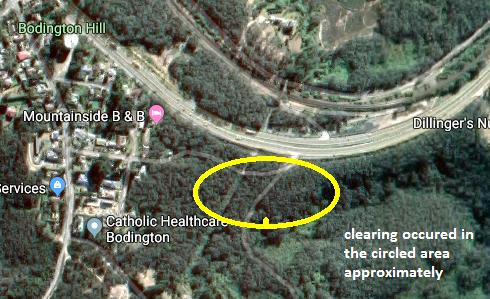 The Location
The site is of high environmental and visual significance in a ‘Land Between Towns’ area, which is meant to provide a vegetated buffer between Bullaburra and Wentworth Falls.
This is the site of the controversial ‘Flora and Fauna Park’ which was the subject of a major community campaign opposing the development 30 years ago.
The development didn’t proceed and the site has been sold several times since, most recently in November 2017.
What happened?
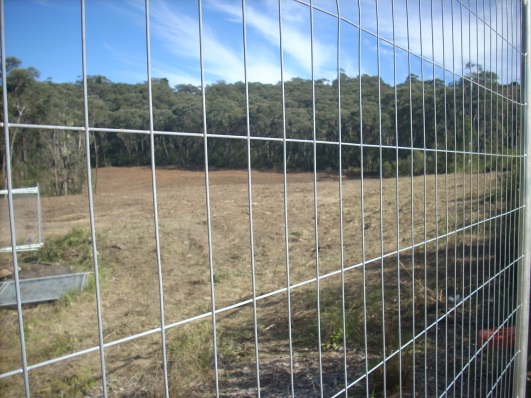 From The Road
No sediment controls could be seen from the fence on the highway on May 9th when several Conservation Society members went to see the damage.
It appears that clearing has been done in the E2 Environmental Conservation zone at the property boundary on the highway, destroying the wildlife corridor leading to the tunnel under the highway.
The clearing was reported to the Council by local residents and the Society.
The immediate concern is the potential for a major silt pollution event downhill into the large swamp and creeks in the next heavy rain.
Why didn’t anyone know about this?
A construction certificate (CC) provided by a private certifier approving the vegetation clearing was lodged with the Council in December 2018. Council has no part to play in this process, other than put the documentation on its website. The private certification system by-passes council and there is no public consultation. The council is the only entity that needs to be notified of the commencement of work done under a CC, at least 2 days before the work begins. The Society is trying to ascertain if the Council was notified.
Was the landclearing legal?
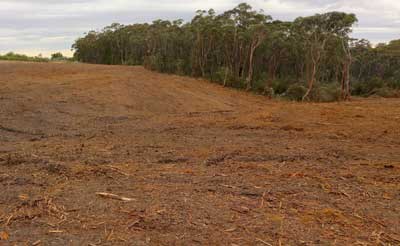 Land Clearing (courtesy Blue Mountains Gazette)
The clearing was undertaken based on a construction certificate issued by a private certifier and Council had no involvement in approving the recent clearing of vegetation on the site (information on the construction certificate can be found here. The Society has raised a number of concerns in regard to the validity of the certificate issued.
This event again raises questions about the private certification approval system in NSW.
The Society is vigorously pursuing the matter with the Council and with MP for Blue Mountains, Trish Doyle.
- See the Society's letter to the Council.
- See Council’s initial response to the Society's letter.
- See the response to Councillor Hoare’s question without notice to council.
- See the Society's letter to the Commonwealth Department of the Environment and Energy.
What is the developer saying that he intends to do with the site?
The developer told the Blue Mountains Gazette 29th May 2019 that the plan is for a $30 million dollar "five to six star" wildlife park development with 40 hotel rooms, which will "attract one million people per year"… "Construction will commence soon. There will be multiple species ... reptiles, koalas, wallabies ... I think the answer is yes [to crocodiles]".
The reference to ‘crocodiles’ relates to the initial 1989 wildlife park development application which included a salt water crocodile display. The developer at the time agreed not to include the crocodiles after intense community pressure. Approval for a wildlife park (without crocodiles) was granted in November 1989.
See the first Blue Mountains Gazette article (May 2019).
See the second Blue Mountains Gazette article (June 2019).
See the Gazette's Croc Park Zombie Development Fine article (September 2019).
Hasn’t the development approval lapsed after 30 years?
Apparently not. This is because in 1996 the NSW Supreme Court, Court of Appeal, found that work that the then owner of the site undertook just days before the development approval was due to lapse (November 1992) did not require building approval and constituted ‘commencement’. If a development is deemed to have ‘commenced’ the development approval apparently never lapses. This has been confirmed by the NSW Department of Planning.
What happens next?
The Society continues to raise concerns in regard to the Flora and Fauna Park development, adjacent to the Great Western Highway at Bodington Hill, Wentworth Falls.
Members of the Landuse Subcommittee have met with senior Council officers, the Mayor, Mark Greenhill, and MP for Blue Mountains Trish Doyle. We understand from our meeting with Council that they are still investigating whether the land clearing was undertaken consistent with the original 1989 development consent.
The Blue Mountains City Council wrote to the Minister for Planning, Rob Stokes, about the problem of ‘in perpetuity’ development consents, citing the case of the Flora and Fauna Park. See Councillor Schreiber’s motion to send the letter, the Council’s letter and the Department of Planning’s response.
See Blue Mountains Gazette article featuring Councillor Schreiber’s continuing campaign against ‘zombie’ development approvals (August 21st 2019).
The Society has also received a response to its complaint to the Building Professionals Board (BPB) in regard to the private certifier who issued the Construction Certificate for the land clearing. The Society raised concerns that the Construction Certificate may have been issued in breach of planning legislation and, potentially, in breach of the development consent. As a result of our complaint, the private certifier was issued with a Penalty Infringement Notice (PIN) for $1,500 for an undisclosed infringement. The BPB informed us that under their disciplinary penalty guidelines and legislation, “specified matters” can be dealt with by issuing a PIN. The BPB would not tell us what the basis for the fine was and also stated that the outcome of the complaint would not be publicly available on the BPB’s online ‘Register of Disciplinary Actions’. We therefore don’t know on what grounds the PIN was issued (ie what infringement the certifier was found to have been guilty of) and what aspects of our complaint were upheld.
This is highly unsatisfactory and points to another problem with the private certification system and its regulation – lack of transparency and full disclosure in relation to the outcomes of complaints made by members of the public and any resulting disciplinary actions. Because of the implications of this case for land clearing throughout the state, the Society lodged a submission in relation to the private certification system and its regulation to the current NSW Legislative Council Public Accountability Committee’s Inquiry into the regulation of building standards, building quality and building disputes. Here's our submission.
We have also written to Rob Stokes (Minister for Planning and Public Spaces), Kevin Anderson (Minister for Better Regulation and Innovation) and Matthew Kean (Minister for Energy and Environment), drawing their attention to these overlooked shortcomings of the private certification system and its regulation. The Society also requested urgent legislative reform to put a time limit on implementing decades old development consents. Both the Flora and Fauna Park and the hotel development adjacent to Katoomba Golf Course are examples of so-called ‘zombie’ DAs being activated decades after the original development consents were issued. Here's our letter to Minister Stokes.
The Society continues to pursue these issues with our local MP Trish Doyle.
Signage goes up at Flora and Fauna Park site
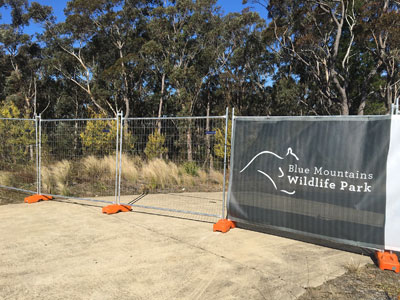 New Perimeter Fencing
Note that a Construction Certificate is an approval, not an application for approval. There will be no opportunity for public consultation.
It is also important to note that the original development consent was for a Flora and Fauna Park only, and any expansion or substantial variation of the development, such as a hotel, will require additional development assessment and consent. The public will be able to comment on any such new plans.
What you can do
The Council still needs to know that the community is appalled by this environmental destruction and that it expects the Council to pursue the matter and potentially take action against the owner and the private certifier if the lawfulness of the Construction Certificate and the clearing is in doubt.
Contact the council by phone on 4780 5000 or email council@bmcc.nsw.gov.au stating your concerns about the landclearing and asking what the council is doing about this.
Also contact the councillors and the mayor. Their contact details can be found on the BMCC website.

We acknowledge the traditional custodians of this land
the Darug and Gundungurra people
and pay respect to their Elders past and present.